Why Memory is Critical for AI Agents
Memory is the foundation that transforms basic AI models into intelligent, adaptive agents. Without memory, every interaction starts from scratch—agents can’t learn from past conversations, remember user preferences, or build context over time. This leads to repetitive questions, inconsistent responses, and frustrating user experiences.
Memory enables AI agents to learn and adapt from feedback, maintain context across conversations, reduce costs by avoiding redundant processing, and deliver truly personalized experiences. It’s what makes the difference between a simple chatbot and an intelligent assistant that understands and grows with you.
Memory Architecture Overview
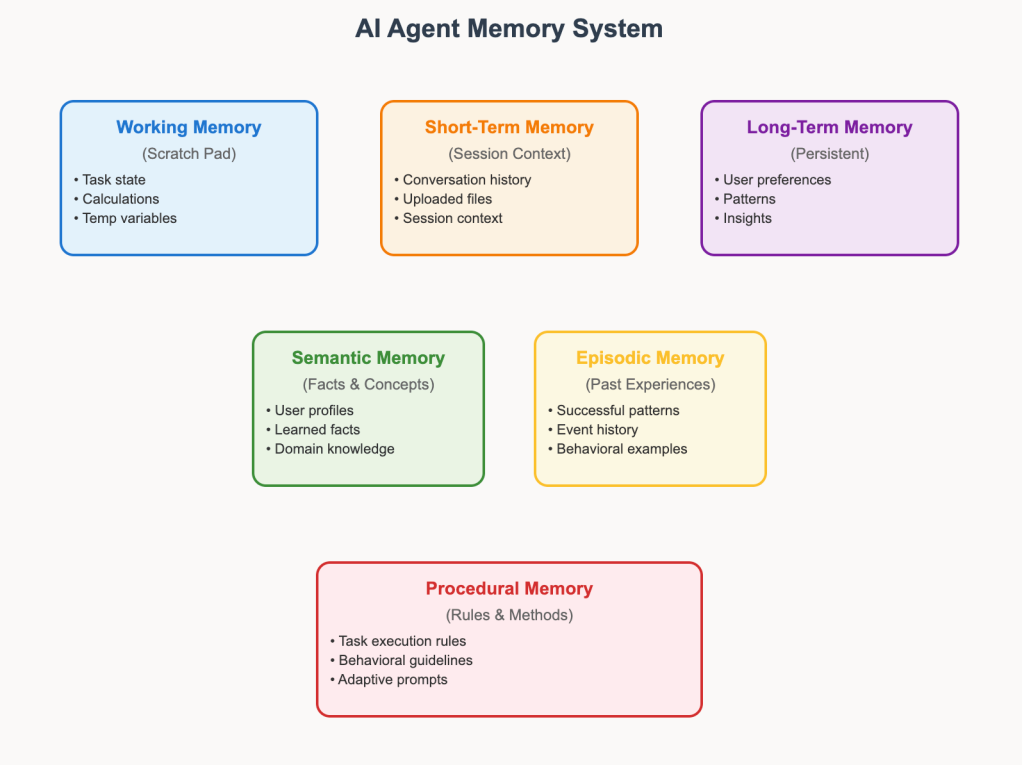
Understanding these memory types helps explain why modern AI assistants are becoming increasingly sophisticated and context-aware.
Working Memory: The Digital Scratch Pad
Working memory serves as an AI agent’s temporary workspace, similar to jotting notes on scratch paper. It stores intermediate information needed to complete immediate tasks, like keeping track of calculation steps or maintaining context during a multi-step process. This memory type is essential for handling complex operations that require incremental state management.
Short-Term Memory: Session-Based Recall
Short-term memory maintains information throughout an active conversation or session. It remembers what you discussed earlier in the chat, uploaded files, and relevant context from the current interaction. However, this memory is ephemeral—once you end the session, it’s gone. This type of memory enables agents to provide coherent, contextual responses without asking you to repeat information within the same conversation.
Long-Term Memory: Persistent Knowledge
Unlike short-term memory, long-term memory persists across sessions and is stored permanently. It captures important user preferences, recurring patterns, and significant insights from past interactions. This memory type allows AI agents to remember your preferences from weeks or months ago, creating continuity across multiple conversations and sessions.
Semantic Memory: Facts and Concepts
Semantic memory stores factual information and learned concepts about users and topics. For AI agents, this includes user details, preferences, and specific facts that should influence future interactions. It’s like having a detailed profile that helps the agent understand who you are and what matters to you, enabling more personalized responses.
Episodic Memory: Learning from Experience
Episodic memory focuses on remembering specific events and experiences—essentially, “how things went” in past interactions. This helps agents learn from successful patterns and avoid repeating mistakes. It’s often implemented through examples that guide the agent’s behavior in similar future situations
Remember that we can help
Learn how KloverTech architects AI for lasting business value in your business processes.
Visit the KloverTech web portal or drop us a line for more AI-related resources, guidance and reporting.
KloverTech puts AI technology to good use, for tangible improvements and results.
https://www.klovertech.io | info@klovertech.io